I may earn a commission at no extra cost to you. #ad
Free Guide: Using Ultrasonic Extraction to Boost Aroma and Flavor Intensity in Craft Beverages
Jump to Section
What is Ultrasonic Extraction?
Ultrasonic extraction, often referred to as sonication, is a cutting-edge technique used by high-end craft beverage producers to pull intense flavors and aromas from raw ingredients in a fraction of the time required by traditional methods. Whether you are working with botanicals, fruits, wood chips, or spices, this technology uses high-frequency sound waves to break down cellular structures and release essential oils and compounds into your liquid base.
In the world of craft brewing, distilling, and non-alcoholic beverage creation, sonication represents the transition from "passive" infusion to "active" extraction. It allows for precision that maceration simply cannot match, giving producers a new lever to pull when seeking that perfect sensory profile.
The Science of Acoustic Cavitation
The magic of ultrasonic extraction lies in a phenomenon called acoustic cavitation. When high-intensity ultrasound is applied to a liquid, it creates alternating high-pressure and low-pressure cycles. During the low-pressure cycle, millions of microscopic vacuum bubbles are formed.
As these bubbles grow and eventually collapse during the high-pressure cycle, they create localized "micro-jets" of liquid and intense shear forces. When these jets hit the surface of your ingredients (like a juniper berry or a vanilla bean), they rupture the cell walls, forcing the flavorful internal compounds out and into the solvent (water, alcohol, or glycerine) instantly.
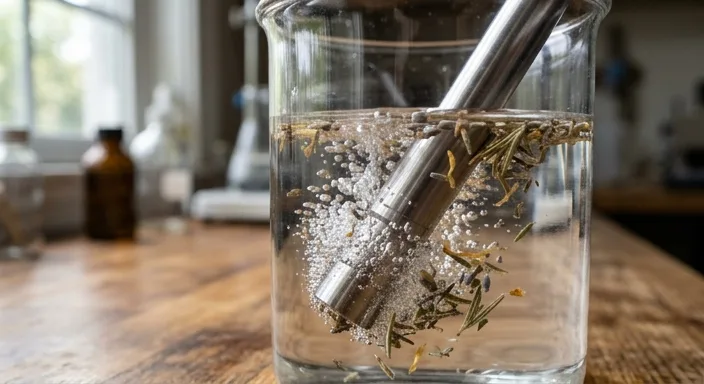
Unlike thermal extraction, which can "cook" delicate compounds and lead to "off-flavors," cavitation is a mechanical process. This means you can extract the "bright" notes of a citrus peel without the bitter, cooked notes associated with boiling.
Benefits for Craft Beverages
- Speed: Reduce extraction times from weeks or months to minutes. This dramatically increases production throughput.
- Higher Yields: Extract more flavor from the same amount of raw material, reducing ingredient costs.
- Cold Extraction: Preserving heat-sensitive aromatics (terpenes and esters) that are often lost in pasteurization or hot steeping.
- Consistency: Digital control over amplitude and time ensures that every batch has the exact same flavor profile.
- Unique Profiles: Access compounds that are difficult to reach with standard alcohol steeping, leading to more complex "top notes" in beverages.
Essential Equipment for Sonication
To implement this in a craft setting, you cannot rely on consumer-grade ultrasonic jewelry cleaners. Professional flavor extraction requires an Ultrasonic Homogenizer (or Probe Sonicator). This setup consists of three main parts:
- The Ultrasonic Generator: This converts standard electrical power into high-frequency electrical energy.
- The Transducer: This converts the electrical energy into mechanical longitudinal vibrations.
- The Titanium Horn (Probe): This is submerged into the liquid and transmits the ultrasonic energy directly into the medium.
For large-scale production, flow-through cells are used, where the liquid is pumped past the probe in a continuous stream, allowing for hundreds of liters to be processed per hour.
Step-by-Step Implementation
Implementing ultrasonic extraction into your workflow follows a specific protocol to ensure safety and quality:
Step 1: Preparation. Grind or chop your botanicals to increase surface area, but avoid turning them into a fine dust which can be difficult to filter later.
Step 2: Submersion. Place the ingredients into your solvent. For spirits, this is typically high-proof ethanol or the final diluted product. For non-alcoholic drinks, this is usually water or a sugar syrup.
Step 3: Sonication. Lower the probe into the mixture. Set your amplitude (usually between 50% and 100%) and your time (starting with 5-10 minute bursts).
Step 4: Temperature Control. Cavitation generates heat. Use a cooling jacket or an ice bath to keep the mixture at your target temperature to prevent volatile loss.
Step 5: Filtration. Once the cycle is complete, filter out the solids. You will notice the liquid has significantly more color and aroma than a standard soak of the same duration.
Optimizing Aroma and Flavor Results
To truly master the craft, you must balance three variables: Amplitude, Time, and Temperature.
Higher amplitude increases the intensity of the cavitation, which is great for tough materials like wood chips or roots. However, for delicate flowers like lavender or elderflower, a lower amplitude for a longer duration may prevent "bruising" the flavor profile.
If your goal is "freshness," keep the temperature below 25°C (77°F). If you are looking for a "toasted" or "extracted" profile (like in rapid oak aging), allowing the temperature to rise slightly can facilitate certain chemical reactions similar to traditional barrel aging.
Common Applications in the Industry
Rapid Spirit Aging: Using ultrasonic energy to force whiskey or rum into and out of oak chips, achieving a 2-year flavor profile in a matter of hours.
Cold Brew Coffee & Tea: Extracting the full caffeine and flavor profile of coffee beans in 5 minutes with cold water, resulting in a smoother, less acidic brew.
Hops Extraction: Increasing the utilization of hops in beer by breaking down lupulin glands more efficiently during the dry-hopping phase.
Bitters and Tinctures: Creating highly concentrated botanical tinctures for cocktails with unparalleled clarity and aromatic "pop."
Frequently Asked Questions
Does ultrasonic extraction damage delicate floral aromas?
No, if managed correctly. Unlike heat-based extraction, ultrasonic extraction can be performed at room temperature or chilled, preserving heat-sensitive volatile compounds that give flowers their true-to-life scent.
How long does the sonication process take?
Most infusions that would normally take days or weeks can be completed in 5 to 30 minutes using a high-intensity ultrasonic probe, depending on the volume and toughness of the material.
What equipment do I need for ultrasonic beverage extraction?
You need an ultrasonic processor (sonicator), consisting of a generator and a titanium probe (horn) that is submerged into the liquid. Standard ultrasonic baths are generally too weak for professional flavor extraction.