I may earn a commission at no extra cost to you. #ad
The Science of Upcycling: How to Transform Food Waste into Premium Flavor Extracts
Jump to Section
- Understanding Upcycling in the Flavor Industry
- The Chemistry of Residual Biomass
- Primary Extraction Methods for Upcycled Flavors
- Case Study: Citrus Peel Terpenes and Flavonoids
- Enhancing Extraction with Enzymatic Hydrolysis
- Quality Control and Food Safety Protocols
- Scaling Up: From Kitchen to Industrial Production
- Frequently Asked Questions
Understanding Upcycling in the Flavor Industry
In the modern culinary landscape, the concept of "waste" is undergoing a radical transformation. Upcycling is not merely about recycling or composting; it is the scientific process of converting low-value food by-products into high-value functional ingredients. For flavor chemists and culinary innovators, this means looking at coffee grounds, fruit pits, and vegetable skins as untapped reservoirs of aromatic compounds.
The economic and environmental benefits are profound. By diverting biomass from landfills, companies reduce their carbon footprint while simultaneously lowering raw material costs. However, the true "premium" aspect comes from the unique flavor profiles achieved through upcycling. Often, the skin or core of a fruit contains a higher concentration of volatile oils and esters than the flesh itself, leading to extracts that are more complex and "true-to-nature" than synthetic alternatives.
The Chemistry of Residual Biomass
To successfully extract flavor from food waste, one must understand the molecular structure of the source material. Residual biomass typically consists of cellulose, hemicellulose, and lignin, which form a rigid cell wall. Within these cells are the target molecules: terpenes, phenols, esters, and aldehydes.
- Terpenes: Found abundantly in citrus peels and herbs, providing bright, top-note aromas.
- Phenols: Present in coffee grounds and cocoa husks, offering smoky, woody, or bitter base notes.
- Esters: Common in fruit scraps like apple cores and pineapple skins, responsible for fruity, sweet characteristics.
The challenge lies in breaking down the cellular matrix without destroying these sensitive volatile compounds. High heat can lead to "cooked" off-notes, while improper pH can cause oxidation, turning a vibrant extract into a dull, brown liquid.
Primary Extraction Methods for Upcycled Flavors
Traditional maceration—soaking scraps in alcohol—is a great starting point, but professional-grade extracts require more sophisticated techniques to achieve potency and clarity.
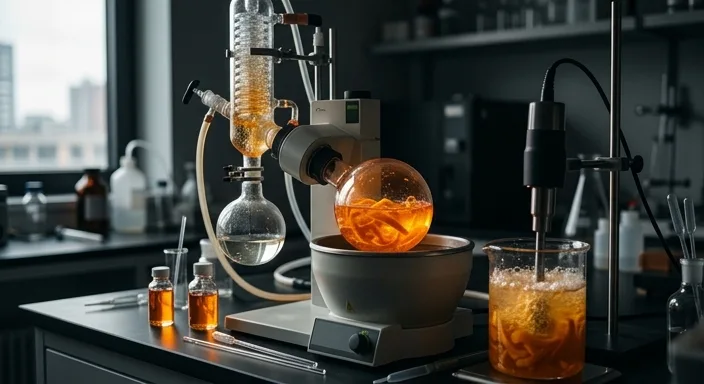
1. Cold Pressing and Centrifugation: Primarily used for citrus. This mechanical method avoids heat, preserving the delicate monoterpenes that give lime or lemon their "zing." Centrifugation then separates the essential oil from the watery juice phase.
2. Ultrasonic-Assisted Extraction (UAE): This method uses high-frequency sound waves to create cavitation bubbles in the solvent. When these bubbles collapse near the plant tissue, they create micro-jets that rupture cell walls, allowing the solvent to penetrate faster. This is highly efficient for extracting antioxidants from grape pomace or coffee grounds.
3. Supercritical CO2 Extraction: Often considered the gold standard, this involves using carbon dioxide at a temperature and pressure where it acts like both a gas and a liquid. It is incredibly precise and leaves no toxic residue, making it ideal for high-end "natural" extracts.
Case Study: Citrus Peel Terpenes and Flavonoids
Citrus processing is one of the largest sources of food waste globally. The peels contain D-limonene, a powerful aromatic compound used in everything from sodas to perfumes. By employing a dual-phase extraction—first using steam distillation for the volatile oils and then a solvent extraction for the bitter flavonoids like naringin—processors can create a "total extract" that provides both aroma and structural bitterness.
When upcycling citrus, it is vital to source organic waste whenever possible, as pesticides tend to concentrate in the oily wax of the peel. Cleaning the biomass with an alkaline wash can help mitigate residual surface contaminants before the extraction process begins.
Enhancing Extraction with Enzymatic Hydrolysis
One of the "secret weapons" in upcycling is the use of enzymes. Pectinase, cellulase, and hemicellulase can be added to the waste biomass to "pre-digest" the cell walls. This enzymatic cocktail breaks down the complex carbohydrates that trap flavor molecules.
For example, when treating apple pomace, pectinase liquefies the solids, significantly increasing the yield of apple esters. This process not only improves the flavor concentration but also reduces the viscosity of the mixture, making subsequent filtration much easier and faster.
Quality Control and Food Safety Protocols
Upcycling introduces unique safety challenges. Because you are dealing with "waste," the microbial load can be higher than with fresh produce. Key safety steps include:
- Rapid Stabilization: Biomass must be processed, frozen, or dried immediately after its primary use to prevent fermentation or mold growth.
- pH Monitoring: Maintaining an acidic environment (pH < 4.6) is often necessary to prevent the growth of pathogens like Clostridium botulinum.
- Water Activity (aw) Control: If creating a dry powder extract, the water activity must be kept low (usually < 0.6) to ensure shelf stability.
Scaling Up: From Kitchen to Industrial Production
Moving from a bench-top experiment to industrial production requires a focus on "mass balance." You must track exactly how much waste goes in versus how much extract comes out. Solvent recovery becomes a critical economic factor; in large-scale operations, ethanol or CO2 is captured and reused to keep costs down.
Standardization is the final hurdle. Unlike synthetic flavors, natural waste varies by season and source. Professional extractors use "standardization by blending"—mixing different batches to ensure that the final product always meets a specific concentration of key aromatic markers (e.g., a minimum of 5% vanillin in a vanilla-waste extract).
Frequently Asked Questions
Can any food waste be turned into a flavor extract?
Not all waste is suitable. Focus on materials with high volatile oil content (citrus, herbs), high sugar/ester content (fruit cores), or deep savory compounds (roasted vegetable scraps). Avoid materials that have begun to rot or ferment unintentionally.
What is the best solvent for home-scale upcycling?
Food-grade ethanol (at least 40% ABV, like vodka or grain alcohol) is the most versatile and safe solvent for most fruit and botanical extractions at home.
How long do upcycled extracts last?
If the alcohol content is above 20% or if the extract is properly acidified and pasteurized, it can last for 12 to 24 months. Store in amber glass bottles away from direct sunlight to prevent light-induced oxidation.