Free Guide: Clean Label Innovation: Natural Flavor Preservation Techniques for Food Scientists
Jump to Section
Understanding the Clean Label Shift
For the modern food scientist, "clean label" is no longer just a marketing buzzword; it is a fundamental formulation requirement. Consumers are increasingly scrutinizing ingredient decks for synthetic preservatives like BHA, BHT, and EDTA. However, removing these stabilizers introduces a significant technical challenge: how do we maintain the integrity of delicate flavor profiles over a 12-month shelf life without traditional chemistry?
Flavor preservation in a clean label environment requires a multi-faceted approach. We must move away from "magic bullet" synthetic additives and toward a "hurdle technology" mindset. This involves understanding the molecular degradation pathways—oxidation, hydrolysis, and polymerization—that turn a vibrant natural strawberry flavor into a dull, "jammy," or even off-note profile.
Botanical Antioxidants: Nature’s Inhibitors
The first line of defense against flavor oxidation is the strategic use of plant-derived antioxidants. While synthetic tocopherols have been used for years, food scientists are now looking toward high-performance botanical extracts that offer superior stability and cleaner declarations.
- Rosemary Extract: Containing carnosic acid and carnosol, rosemary is perhaps the most effective natural antioxidant for lipid-based flavors. The challenge lies in removing the "piney" sensory notes of the rosemary itself, necessitating the use of deodorized extracts.
- Acerola Cherry: A potent source of natural Vitamin C (ascorbic acid), acerola is excellent for preventing the browning and oxidative degradation of citrus and fruit-based flavor systems.
- Green Tea Extracts: Rich in catechins, these are highly effective in aqueous systems but require careful dosing to avoid astringency.
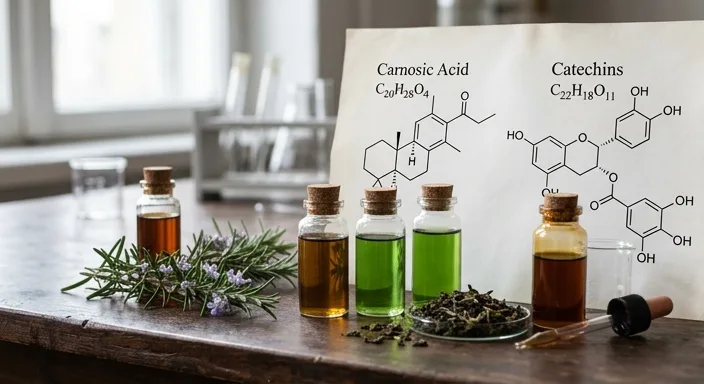
The key to success with botanical antioxidants is synergy. Research shows that combining rosemary extract with mixed tocopherols often provides a greater oxidative stability index (OSI) than either ingredient used alone at the same total concentration.
Advanced Encapsulation for Volatile Retention
Natural flavors are notoriously volatile. Many of the top notes that define a "fresh" profile are the first to escape through packaging or degrade during thermal processing. Clean label encapsulation provides a physical barrier to protect these molecules.
Traditional encapsulation often relied on modified food starches. In the clean label space, we are seeing a shift toward:
- Native Starches and Gums: Using gum arabic or pea protein isolates to create a protective matrix via spray drying.
- Liposomal Delivery: Encapsulating flavor oils within phospholipid bilayers, which can significantly improve the stability of oil-in-water emulsions.
- Yeast Cell Encapsulation: A fascinating "upcycled" approach where flavor molecules are infused into the empty shells of yeast cells (spent yeast), providing incredible thermal protection.
Water Activity and pH Control in Natural Systems
The environment surrounding a flavor molecule dictates its lifespan. High water activity (aw) facilitates hydrolytic reactions that break down esters—the building blocks of many fruit flavors. By managing water activity through the use of natural humectants like honey, fruit concentrates, or specialized fibers, scientists can effectively "lock" flavors in place.
Similarly, pH control is vital. Many natural pigments and flavor compounds are pH-sensitive. Using natural acidulants like buffered vinegar, lemon juice concentrate, or fermented sugar can stabilize the environment without triggering "chemical-sounding" names on the label.
Processing Innovation: HPP and Cold Pasteurization
Sometimes the best preservation technique isn't what you add, but what you *don't* do. High-heat pasteurization (UHT/HTST) is the enemy of natural aroma. It triggers Maillard reactions and caramelization, masking the intended flavor profile.
High-Pressure Processing (HPP), often called "cold pasteurization," uses extreme pressure rather than heat to inactivate microbes. This keeps the flavor molecules intact, allowing for a "fresh-squeezed" taste that remains stable for weeks in the cold chain. For shelf-stable products, Aseptic Processing combined with rapid cooling is the gold standard for preserving clean-label aromatics.
Overcoming Shelf-Life Degradation
To truly innovate in the clean label space, food scientists must employ rigorous shelf-life testing. Accelerated aging studies (storing samples at 35°C or 40°C) help predict how natural antioxidants will hold up over time. However, be cautious: natural systems don't always follow the Arrhenius equation linearly. A flavor that survives 4 weeks at 40°C might still fail at 12 months at ambient temperature due to the slow polymerization of terpenes.
The use of opaque packaging or UV-blocking films is a crucial "external" preservation technique. Many natural flavors, particularly citrus oils containing citral, are highly photosensitive and will develop "terpy" or "soapy" off-notes within days of light exposure.