I may earn a commission at no extra cost to you. #ad
Free Guide: A Step-by-Step Manual to Flavor Encapsulation in Modern Food Science
Jump to Section
What is Flavor Encapsulation?
In the world of modern food science, flavor encapsulation is the specialized process of trapping a target "active" ingredient—in this case, a liquid or volatile flavor compound—within a protective matrix known as the "wall" or "shell" material. This creates a micro-capsule where the flavor is shielded from its external environment.
Think of it as a biological cell; the flavor is the nucleus, and the encapsulation material is the cell membrane. This technology allows food chemists to transform volatile liquids into stable powders, control exactly when a flavor hits the palate, and prevent the "fading" of aroma that often occurs during a product's shelf life.
The Primary Benefits of Encapsulating Flavors
Why do manufacturers invest in the complex equipment required for encapsulation? The reasons go beyond simple convenience:
- Oxidation Protection: Many essential oils and citrus flavors react with oxygen, leading to "off-notes" (like the fishy smell in degraded omega-3s or the soapy taste in oxidized lemon oil). Encapsulation provides a physical barrier against oxygen.
- Thermal Stability: During baking or extrusion, high temperatures can destroy delicate flavor molecules. Encapsulation shields the flavor until the final cooking stages.
- Controlled Release: You can design capsules to break only when chewed (mechanical release), when they hit a certain pH in the mouth/stomach, or when they reach a specific temperature.
- Handling & Solubility: Turning an oily flavor into a free-flowing powder makes it much easier to mix into dry beverage bases or spice rubs.
Core Techniques in Modern Food Science
Depending on the flavor type and the desired end-use, food scientists choose from several primary technologies:
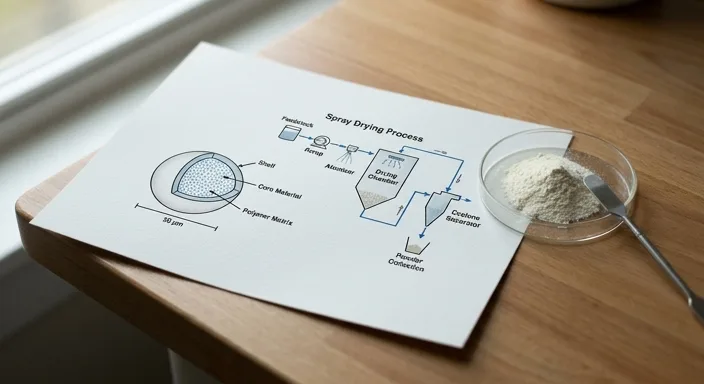
1. Spray Drying
The industry gold standard. A flavor is emulsified into a solution of wall material (like maltodextrin) and then sprayed through a nozzle into a hot air chamber. The moisture evaporates almost instantly, leaving behind dry, encapsulated particles.
2. Coacervation
Often called "true" microencapsulation. It involves phase separation in a liquid medium. It is more expensive but creates a very robust shell, often used for high-end fragrances and high-load flavor oils.
3. Spray Chilling
Similar to spray drying, but instead of hot air, cold air is used to solidify a lipid-based wall (like vegetable fat or wax) around the flavor. This is excellent for creating "burst" flavors in frozen or refrigerated goods.
Choosing the Right Coating Materials (Wall Materials)
The "wall" material determines the stability and release characteristics of your flavor. Selection is critical:
- Carbohydrates: Maltodextrins and corn syrup solids are popular because they are cheap and have high solubility. Modified starches are used to improve emulsion stability.
- Gums: Gum Arabic is the classic choice due to its excellent emulsifying properties and low viscosity at high concentrations.
- Proteins: Gelatin, whey protein, and soy protein provide excellent film-forming capabilities and can be cross-linked for slower release.
- Lipids: Hydrogenated vegetable oils and waxes are used when a moisture barrier is the primary goal.
Step-by-Step Process for Successful Encapsulation
Follow these five steps to ensure a high-quality encapsulated flavor product:
- Emulsion Preparation: Mix your flavor oil with a solution containing your wall material and an emulsifier. Use high-shear mixing to create tiny oil droplets (ideally 1–3 microns).
- Optimization: Adjust the solids content. Higher solids (usually 30-45%) lead to better retention and faster drying times.
- Atomization: Pass the emulsion through the encapsulation equipment (e.g., the spray dryer nozzle). The droplet size here dictates the final particle size.
- Dehydration/Solidification: The "shell" hardens as solvent (usually water) is removed or as the lipid cools.
- Collection & Stabilization: The dry powder is collected via a cyclone. It must be stored in airtight containers to prevent moisture re-absorption, which can cause "clumping."
Measuring Success: Release Profiles and Stability
How do you know if your encapsulation worked? Scientists look at two main metrics:
Encapsulation Efficiency: This measures how much of the flavor is actually inside the capsule versus how much is "surface oil." High surface oil leads to rapid oxidation and poor shelf life.
Release Profile: Using analytical tools like GC-MS (Gas Chromatography-Mass Spectrometry), researchers measure the "headspace" of a product to see when the flavor molecules are released. In a successful "timed-release" capsule, you should see zero flavor release in the package and a massive spike upon contact with water or heat.
Frequently Asked Questions
Yes, slightly. The wall materials (like maltodextrin or gelatin) must be included in the ingredient deck and will contribute to the total carbohydrate or protein count, though usually in very small amounts.
Yes, though it is more difficult than oil-soluble flavors. Techniques like "double emulsion" (water-in-oil-in-water) are typically required to prevent the flavor from leaching into the carrier during processing.
Generally, encapsulated flavors last 12 to 24 months, significantly longer than liquid flavor oils which may begin to oxidize within 3 to 6 months if not refrigerated.